
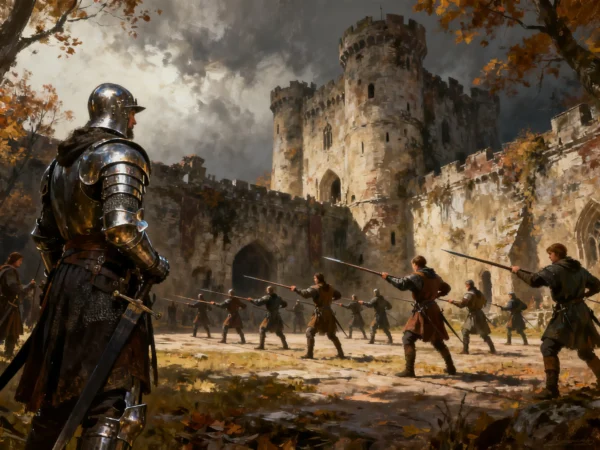
How to Run Your First D&D Campaign: A Beginner DM’s Guide
Running your first D&D campaign doesn't require memorizing every rule or preparing an entire fantasy world. This beginner DM guide covers the essential steps for preparing, running, and enjoying your first campaign.
Running your first Dungeons & Dragons campaign can feel intimidating.
Suddenly, you’re expected to describe an entire fantasy world, portray dozens of characters, understand the rules, manage combat, react to unpredictable players, and somehow keep a story moving forward.
Here’s the good news: you don’t need to be an expert to be a good Dungeon Master.
You don’t need to memorize every rule. You don’t need elaborate terrain or professional voice acting. You certainly don’t need to know what your players are going to do before they do it – because you probably never will.
A good first campaign comes down to understanding the adventure, preparing what you’re likely to need, giving your players room to make decisions, and being willing to improvise when things inevitably go somewhere unexpected.
This beginner DM’s guide walks through the first steps.
What Does a Dungeon Master Actually Do?
The Dungeon Master, or DM, serves as the narrator, referee, and facilitator of a D&D game.
Players generally control one character each. The DM controls virtually everything else: the world, its inhabitants, enemies, allies, locations, and the consequences of the players’ actions.
If the party enters an abandoned temple, you describe what they see.
If they speak to the innkeeper, you portray the innkeeper.
If goblins attack, you control the goblins.
If someone attempts something unusual, you determine what happens, often using the game’s rules and dice to resolve the outcome.
But your job isn’t to beat the players.
You’re creating an adventure together. Present challenges, portray the world honestly, and give the players opportunities to succeed – or fail – based on their decisions.
1. Choose the Right Adventure
For your first campaign, using a published adventure can make becoming a DM considerably easier.
Instead of inventing an entire world, storyline, cast of characters, encounters, and dungeons yourself, you’ll have a framework to work from.
Look for an adventure that provides more than maps and encounters. A beginner-friendly campaign should help you understand:
- What is happening in the story
- What the players are expected to accomplish
- Who the important NPCs are
- What motivates the villains
- How encounters connect to the larger narrative
- What information players should discover
- How to handle likely player decisions
Also consider the experience level of your players. If everyone is learning D&D together, beginning at Level 1 provides an opportunity to learn characters and abilities gradually.
2. Understand the Story – Don’t Memorize the Book
One of the biggest mistakes a new DM can make is believing they need to memorize an entire campaign before playing.
You don’t.
Before beginning, read enough of the adventure to understand its overall premise, major characters, central conflict, and where the story is ultimately heading.
Then concentrate your preparation on the next session.
If your players are arriving at a frontier fortress this week, you probably don’t need to memorize the dungeon they may explore six sessions from now.
Knowing the larger story gives you direction. Knowing the next session gives you confidence.
3. Hold a Session Zero
Before the adventure begins, gather everyone for a Session Zero.
This is a meeting where the group establishes characters, expectations, and how the game will work.
Discuss things such as:
- What kind of campaign you’re playing
- Character creation
- How the characters know one another
- The campaign’s tone and themes
- House rules
- Scheduling and session length
- Player comfort and boundaries
- Expectations around attendance and behavior
This is also a good opportunity to explain that D&D is collaborative.
Players should be free to make decisions, but everyone at the table shares responsibility for keeping the game enjoyable.
A character can attempt to rob every merchant they meet. That doesn’t necessarily mean doing so will make for a better campaign.
4. Prepare Your First Session
Once you understand the adventure, focus specifically on what you’re likely to need during your first session.
Know the important locations the characters may visit, NPCs they’re likely to meet, encounters they could face, and clues or information they might discover.
Keep important information easily accessible.
For an NPC, you may only need:
Captain Arlen
Gruff veteran. Distrusts inexperienced adventurers. Wants the eastern road secured.
That’s often more useful during play than three paragraphs of biography.
The same principle applies to locations and encounters. Prepare enough information to confidently present them, but don’t bury yourself beneath unnecessary notes.
5. Learn the Core Rules, Not Every Rule
You should understand the fundamentals:
- Ability checks
- Saving throws
- Attack rolls
- Armor Class
- Hit points and damage
- Movement
- Actions and Bonus Actions
- Advantage and Disadvantage
- Resting
- Basic spellcasting
You do not need every spell, condition, class feature, or obscure interaction memorized.
When an unfamiliar rule comes up, you can look it up. If doing so would bring the game to a halt, make a reasonable ruling, keep playing, and check the exact rule afterward.
A confident temporary ruling is often better than spending ten minutes searching through rulebooks while everyone waits.
6. Let Players Make Decisions
A published campaign has a story, but D&D isn’t a novel.
Your players aren’t there simply to perform the actions written in the adventure.
Perhaps the book expects them to interrogate a captured enemy, but they release him instead. Maybe they’re supposed to negotiate with an NPC they immediately distrust. Perhaps they devise a clever way around an encounter you expected to occupy half the session.
That’s normal.
The DM’s job is to determine how the world responds.
Player choices don’t necessarily need to rewrite the campaign’s ultimate destination to matter. They can influence relationships, allies, rewards, information, reputation, and how future situations unfold.
Give players room to leave their fingerprints on the journey.
7. Learn to Say “Yes, But…”
Players will attempt things you never anticipated.
Frequently.
Instead of immediately deciding something isn’t allowed, consider whether it is merely difficult.
A player wants to convince the suspicious guard to let them through?
Let them try.
A character wants to leap from a balcony onto a passing wagon?
There’s probably a roll for that.
Someone wants to disguise themselves as the goblin chief using a blanket, charcoal, and an aggressively optimistic interpretation of the rules?
Well… let’s hear the plan.
You don’t have to allow the impossible, and success shouldn’t be guaranteed. But some of the most memorable moments in D&D begin when a player asks:
“Can I try something?”
8. Don’t Be Afraid of Improvisation
Eventually your players will ask the name of an NPC who doesn’t have one.
They’ll enter a building the adventure never describes.
They’ll become suspiciously interested in a completely irrelevant object you mentioned for atmosphere.
Welcome to Dungeon Mastering.
Make something up.
Write it down if it becomes important.
Keep moving.
Players generally cannot tell the difference between something you’ve been planning for three months and something you invented twelve seconds ago.
Sometimes the improvised material becomes more memorable than what was originally planned.
9. Keep the Game Moving
Pacing matters.
If players are debating the same decision for twenty minutes, introduce new information or ask what they’re doing.
If combat has become repetitive, make enemies retreat, surrender, change tactics, or otherwise advance the situation where appropriate.
If the group becomes stuck on a puzzle or investigation, provide another path toward the information they need.
This doesn’t mean rushing players. Give important scenes room to breathe.
The goal is simply to recognize when thoughtful play has become stagnation.
10. Remember That Failure Can Advance the Story
Not every failed roll needs to mean:
“Nothing happens.”
Suppose the party attempts to pick a lock and fails. Instead of simply leaving them staring at a locked door, perhaps they eventually force it open – but make enough noise to alert whatever is waiting beyond it.
They failed, and the failure mattered.
Likewise, losing a battle doesn’t always require a total party kill. Characters might be captured, forced to retreat, lose an important resource, or allow an enemy to escape.
Failure can create consequences rather than dead ends.
11. Don’t Overprepare
New Dungeon Masters frequently spend hours preparing material players never encounter.
Preparation is useful. Overpreparation can become a trap.
Focus most heavily on things difficult to improvise quickly:
- Important encounters
- Maps
- Stat blocks
- Major NPC motivations
- Essential clues
- Treasure
- Complicated rules relevant to the session
Leave yourself room everywhere else.
You aren’t writing a screenplay. You’re preparing possibilities.
12. Give Yourself Permission to Make Mistakes
You will forget rules.
You will call an NPC by the wrong name.
You will accidentally make an encounter easier or harder than intended.
Your carefully practiced villain voice may inexplicably become Scottish halfway through the conversation.
None of this means you’ve failed as a Dungeon Master.
Most players care far more about whether the session was fun than whether every rule was applied perfectly.
When you make an important mistake, correct it when appropriate and move on.
Every session makes running the next one easier.
What Do You Actually Need to Start DMing?
Probably less than you think.
At minimum, you’ll want access to the appropriate D&D rules, character sheets, dice or a digital dice roller, and an adventure – or your own material – to run.
Maps, miniatures, virtual tabletops, terrain, DM screens, ambient music, and other accessories can enhance the experience, but none are requirements for becoming a Dungeon Master.
Start simple.
You can always add more as you discover what your group enjoys.
Looking for a Beginner-Friendly D&D Campaign?
If you’re preparing to run your first long-form adventure, The Hollow Prince Saga Pt 1: The Cursed Heir was created to help make that transition easier.
Players begin at Level 1 as inexperienced conscripts arriving at a remote frontier keep. Their early assignments introduce the world and its dangers before gradually developing into a sprawling dark-fantasy adventure involving ancient mysteries, political intrigue, dangerous enemies, and a prophecy with potentially catastrophic consequences.
The campaign spans 10 story-driven chapters, with each chapter supported by a GM Synopsis explaining the events happening behind the scenes, important NPCs and factions, narrative themes, long-term implications, and practical guidance for bringing the adventure to life.
Rather than requiring a first-time DM to piece together why everything matters, the campaign is designed to provide the context needed to understand the story while still leaving room for the GM and players to make the adventure their own.
Your First Campaign Starts With Your First Session
Don’t wait until you know every rule.
Don’t wait until you’ve created the perfect gaming room.
And don’t worry about running your campaign exactly like the professional games you’ve watched online.
Gather some friends. Learn the fundamentals. Prepare your first adventure.
Then start playing.
The rest you’ll learn along the way.